Varicose veins are very common in older adults. They can cause symptoms such as pain, heaviness, tiredness, itching, and swelling in the legs. In some cases, varicose veins are associated with chronic venous disease, which can lead to skin changes and even leg ulcers.
Aging increases the likelihood of developing varicose veins, but having them does not necessarily mean that a serious complication will occur. In addition, not everyone with varicose veins needs treatment.
This article explains what varicose veins are, why they become more common with age, which symptoms deserve attention, and which treatments may be available.
Disclaimer: This article is intended for educational purposes and does not replace medical evaluation. If you experience severe pain, sudden swelling of one leg, shortness of breath, chest pain, or other sudden symptoms, seek medical attention immediately.
What are varicose veins?
Varicose veins are enlarged and twisted veins that are usually visible beneath the skin of the legs. They develop mainly when the valves inside the veins do not work properly and cannot adequately prevent blood from flowing backward.
Normally, the veins in the legs must transport blood back toward the heart against gravity. The valves inside the veins help keep blood flowing in the correct direction.
When these valves become incompetent, some blood can flow backward and accumulate in the veins of the legs. This increases pressure inside the veins and can cause them to become enlarged and tortuous.
Varicose veins are part of a spectrum of conditions known as chronic venous disease. This condition can range from visible veins to more advanced problems involving swelling, skin changes, and venous ulcers.
Why are varicose veins more common in older adults?
The risk of developing varicose veins increases with age. This is partly because the structures of the veins and their valves undergo changes over time.
A prospective study of 6,241 adults aged 66 to 70 years who were followed for approximately 13 years identified new clinically recognized varicose veins in about 6% of participants. A higher body mass index, greater height, and female sex were associated with a higher risk of developing varicose veins. [1]
Other factors may also contribute, including:
- family history of varicose veins or venous disease;
- overweight or obesity;
- prolonged periods of standing;
- previous deep vein thrombosis;
- physical inactivity;
- age-related changes in the veins;
- conditions that increase pressure inside the abdomen.
Therefore, varicose veins are not simply an unavoidable consequence of aging. Several factors can influence their development.
What are the symptoms of varicose veins in older adults?
Some people have varicose veins without any symptoms. Others may experience significant discomfort.
Common symptoms include:
- a feeling of heaviness in the legs;
- pain or discomfort;
- tired or aching legs;
- burning sensation;
- itching;
- tingling;
- leg cramps;
- swelling, particularly around the ankles;
- throbbing or pulsating sensations;
- symptoms that worsen after standing for a long time.
Symptoms often become more noticeable toward the end of the day and may improve when a person sits down, rests, or elevates their legs.
Can varicose veins cause leg swelling?
Yes. Leg swelling, particularly around the ankles, can occur when chronic venous disease is present.
Increased pressure inside the veins can promote the accumulation of fluid in the tissues of the legs. In some people, swelling is mild and becomes more noticeable toward the end of the day.
However, not all leg swelling is caused by varicose veins. Heart, kidney, or liver problems, medications, and other medical conditions can also cause swelling.
For this reason, persistent or unexplained leg swelling should be evaluated by a healthcare professional.
Can varicose veins cause skin problems?
In more advanced cases of chronic venous disease, changes in circulation can lead to changes in the skin of the legs.
Possible changes include:
- darkening of the skin, particularly around the ankles;
- dry skin;
- itching;
- thickening or hardening of the skin and underlying tissue;
- inflammation;
- wounds or venous ulcers.
It is important to remember that not everyone with varicose veins will develop ulcers. The presence of extensive varicose veins alone does not mean that a serious complication will necessarily occur.
Can varicose veins cause blood clots?
This is an important question.
A large observational study published in JAMA followed more than 425,000 adults and found an association between varicose veins and a higher subsequent occurrence of deep vein thrombosis. The association was particularly strong for deep vein thrombosis, although the researchers emphasized that the study could not establish that varicose veins directly cause the increased risk. [4]
This means that having varicose veins does not mean that a person will develop a blood clot.
However, new or significant symptoms, especially symptoms that develop suddenly, should not automatically be attributed to varicose veins.
When should you seek medical attention quickly?
Seek prompt medical attention if you develop:
- sudden swelling in one leg;
- significant unexplained pain in one leg;
- a sudden increase in the size of one leg;
- localized redness or warmth;
- sudden shortness of breath;
- chest pain;
- coughing up blood;
- fainting or severe lightheadedness.
These symptoms can have several causes, but some may indicate deep vein thrombosis or pulmonary embolism, which require urgent medical evaluation.
How are varicose veins diagnosed?
Diagnosis usually begins with a clinical evaluation.
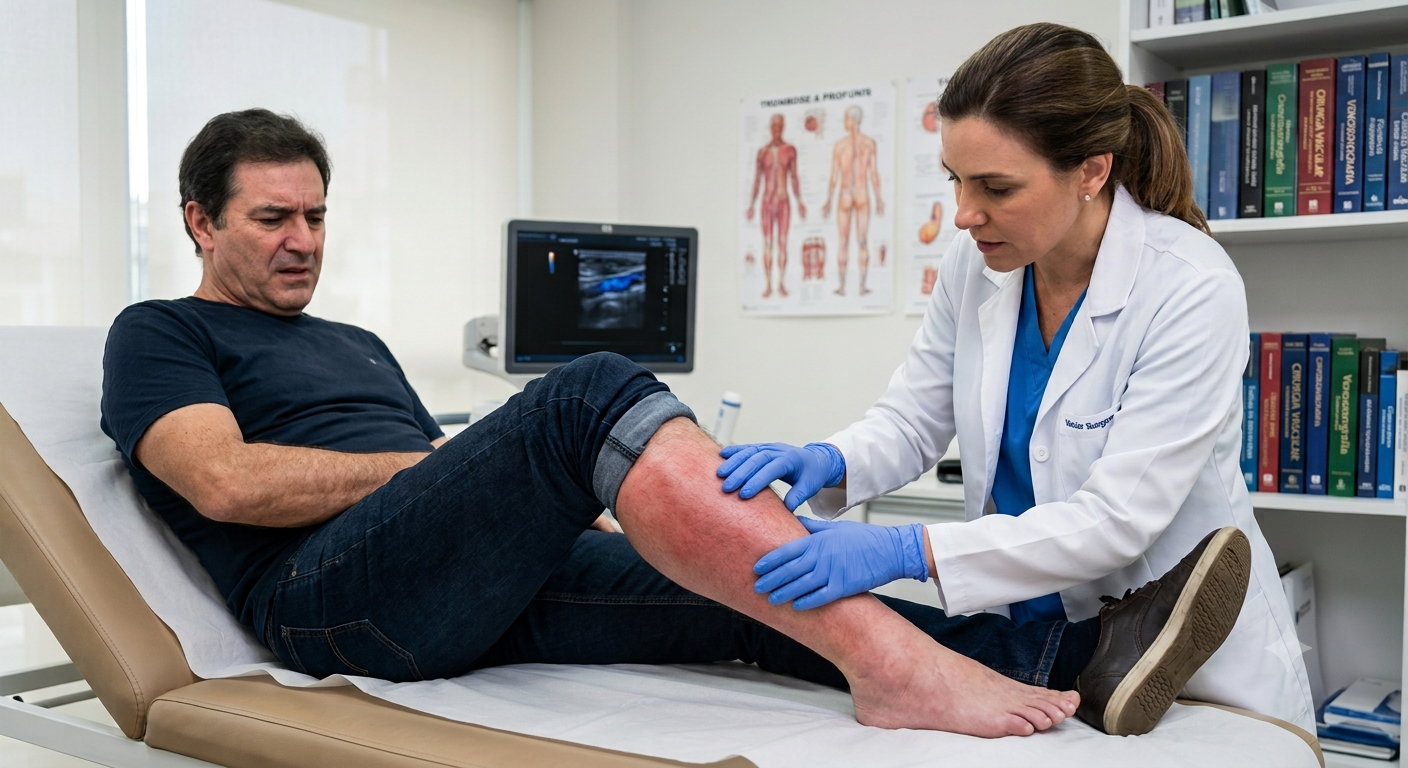
A healthcare professional examines the legs, looks at the veins, and checks for signs such as swelling, skin changes, wounds, and other manifestations of chronic venous disease.
When more detailed evaluation of the veins is needed, a venous Doppler ultrasound, also called duplex ultrasonography, may be requested.
This test evaluates blood flow and can identify problems such as abnormal venous reflux and blockages.
The evaluation can also help distinguish varicose veins from other causes of leg pain or swelling.
How are varicose veins treated in older adults?
Treatment depends on the person’s symptoms, the extent of the disease, the characteristics of the affected veins, and their overall health.
Not everyone with varicose veins needs a procedure.
Treatment options may include conservative measures, compression therapy, medications in selected situations, and procedures that close or remove abnormal veins.
Treatment should be individualized by a qualified healthcare professional.
1. Physical activity
Physical activity can help improve the function of the calf muscle pump.
When we walk, the calf muscles contract and help push blood from the legs toward the heart.
For many older adults, regular walking is a simple way to keep the legs active.
Exercise should, however, be adapted to each person’s physical condition and abilities.
2. Avoid staying in the same position for too long
Remaining seated or standing for prolonged periods can promote blood pooling in the legs.
When possible, it can be helpful to:
- stand up regularly;
- walk for a few minutes;
- move the feet and ankles;
- avoid sitting for long periods without moving.
These measures can be particularly useful for older adults who spend much of the day sitting.
3. Elevate your legs
Elevating the legs while resting may help reduce discomfort and swelling in some people.
One simple strategy is to lie down and keep the legs elevated for a period of time, particularly after spending a long time standing.
Leg elevation can help relieve symptoms, but it does not correct the underlying cause of varicose veins.
4. Compression stockings
Compression stockings may be useful in certain situations, particularly for relieving symptoms associated with chronic venous disease.
However, they should not automatically be used by everyone with varicose veins.
Before using compression, especially in older adults, it is important to assess arterial circulation in the legs. People with significant peripheral arterial disease may require specific precautions and should not simply start compression therapy on their own.
In addition, evidence for the benefit of compression stockings in people with varicose veins without venous ulcers is not as strong as many people assume. [2,5]
Therefore, the appropriate type and level of compression should be determined by a healthcare professional when compression is indicated.
5. Weight management
Excess body weight is associated with a higher risk of developing varicose veins in older adults. [1]
For people who are overweight or obese, gradual weight loss may be part of an overall strategy to improve cardiovascular health and reduce some leg-related symptoms.
The goal should not be limited to treating varicose veins, but rather to improving overall health.
6. Procedures for treating varicose veins
When varicose veins cause significant symptoms or complications, a specific treatment for the affected veins may be recommended.
Depending on the situation, procedures may include:
- sclerotherapy;
- endovenous thermal ablation using laser or radiofrequency;
- other endovenous techniques;
- ambulatory phlebectomy;
- conventional surgery in selected cases.
Minimally invasive techniques have evolved considerably over the past several decades and, for many patients, can offer a faster recovery than traditional surgical techniques. [2,5]
The choice of procedure depends on the anatomy of the veins, symptoms, Doppler ultrasound findings, the patient’s overall health, and their treatment goals.
Does every older adult with varicose veins need surgery?
No.
Having varicose veins does not automatically mean that surgery is necessary.
Some people have varicose veins primarily as a cosmetic concern and do not have significant symptoms. Others may have symptoms that can be managed with conservative measures.
On the other hand, people with significant pain, persistent swelling, important skin changes, ulcers, bleeding, or other complications may need an evaluation for an interventional treatment.
The Brazilian guidelines for chronic venous disease emphasize that treatment should take the individual characteristics of each patient into account and that recommendations should be applied on a case-by-case basis. [6]
Can varicose veins go away on their own?
In general, established varicose veins do not disappear on their own.
Measures such as physical activity, leg elevation, and weight management may improve symptoms, but they usually do not eliminate varicose veins.
When treatment is indicated to eliminate or close abnormal veins, procedures such as sclerotherapy or endovenous ablation may be considered.
Therefore, treatment may aim to improve symptoms, prevent or manage complications, or address the appearance of the veins, depending on the individual situation.
Do creams and ointments get rid of varicose veins?
There is no good evidence that ordinary creams or ointments can permanently eliminate a varicose vein.
Some products may provide temporary relief or a cooling sensation, but this is different from treating the underlying vein problem.
Similarly, supplements and products marketed as “natural” treatments should not be considered substitutes for medical evaluation.
When should an older adult see a doctor?
Medical evaluation is recommended when varicose veins:
- cause frequent pain or discomfort;
- are associated with persistent swelling;
- are progressively worsening;
- cause itching or skin changes;
- cause wounds;
- bleed;
- become painful or hard;
- interfere with daily activities;
- raise concerns about circulation in the legs.
It is also important to seek medical attention when symptoms change suddenly, particularly if significant pain or swelling develops in only one leg.
Frequently asked questions about varicose veins in older adults
Are varicose veins dangerous in older adults?
Most of the time, varicose veins are not an emergency. However, they can be associated with chronic venous disease and, in some cases, complications such as skin changes, ulcers, bleeding, and blood clots. Significant symptoms should therefore be evaluated.
Does walking help varicose veins?
It can help. Walking activates the muscles of the legs, especially the calf muscles, which contribute to the return of venous blood toward the heart. Regular physical activity also contributes to cardiovascular health and weight management.
Is it better to sit or stand when you have varicose veins?
Neither is ideal for prolonged periods. The most important thing is to avoid staying in the same position for too long and to move your legs regularly.
Does sleeping with your legs elevated help?
Elevating your legs while resting may help reduce swelling and discomfort in some people. However, it does not eliminate varicose veins.
Do compression stockings cure varicose veins?
No. Compression can help control some symptoms of chronic venous disease, but it does not eliminate varicose veins. In addition, not every older adult should use compression stockings without professional guidance.
Do varicose veins always need treatment?
No. Treatment depends on symptoms, complications, examination findings, and the patient’s goals. Some people can simply be monitored without undergoing a procedure.
Which doctor treats varicose veins?
Diagnosis and treatment may involve a vascular specialist, such as a vascular surgeon or phlebologist, depending on the situation. These professionals can assess circulation in the legs and determine whether specific treatment is necessary.